
Dover Township City Directory Collections
There is no verified uninterrupted Dover Township printed-directory run. The strongest evidence points to York City and County or York-area books held or described by the York County History Center, the FamilySearch catalog, and the Library of Congress. That distinction matters because Dover Borough is separate from Dover Township, and a title that says York or vicinity does not prove that every Township address appears. Use each book's introduction, geographic headings, or a confirmed Dover entry to decide whether it belongs in a household trail.
| Collection | Years | Where | Access |
|---|---|---|---|
| Boyd's York Directory and principal county towns | 1881-82; 1883-84; 1887-88 | FamilySearch catalog and History Center evidence | Inspect the named volume and its scope |
| Young's York City and County directory | 1886; 1889; 1890; 1892 | History Center guide and catalog evidence | Repository research |
| Bell and York Directory Co. city-and-county titles | 1894-95; 1896-97 | History Center style-guide evidence | Confirm Dover coverage in the volume |
| R. L. Polk York-area directories | 1898, 1899, 1902, 1903, 1905, 1907 | History Center and FamilySearch catalog evidence | Volume-specific review |
| York, Pennsylvania & vicinity criss-cross directories | 1973; 1989-1995 | Library of Congress holdings | On-site reader registration and request |
Gaps are part of the answer. The evidence does not establish a first or last complete Dover Township publication, and it does not establish that every listed year contains all Township households. Record each printed volume as a dated lead with its exact title, year, page, and scope.
York-Area Directory Books for Dover
York County's records geography explains the countywide shelf. Dover Township has no separate historical-directory office, while the History Center gathers York City and County directories alongside maps, yearbooks, local newspaper microfilm, and property material. A search should begin with the correct surname spelling and the nearest known year. If a household is not in one book, try a nearby verified year before deciding the person was absent.
The History Center Family Research Guide also identifies church-derived vital-statistics cards, cemetery cards, tax abstracts, will and Orphans' Court abstracts, and cross-reference material. These companions can support or challenge a directory lead. They should not be combined into an unsupported claim that one person occupied an address on a modern date.
Dover Township Historical Research Desk
The York County History Center research service is the main in-person route for historical Dover work. Its Library & Archives is at 121 N. Pershing Avenue in York and takes researchers by appointment Tuesday through Saturday, 10 a.m. to 4 p.m. Day admission is listed as $12, with lower or free categories for seniors, members, and students. Reserve a reading-room seat before relying on a same-day visit. Staff and volunteers can help locate a collection, but they do not turn a partial directory into a full Township census.
The History Center Library & Archives holdings page shows the repository assigned to this Dover Township research. It is a useful first stop for planning which directories, surname files, maps, yearbooks, and newspaper sources to request.

At the reading room, users can consult on-site Ancestry Library Edition, Pennsylvania Newspapers.com, local microfilm, and Fold3 where available. The Center allows cell-phone photography of documents and books under reading-room rules, which differs from the Recorder's restriction on photographing its books or computer screens.
Reading a Dover Township Directory Entry
No digitized York or Dover entry and no abbreviation page was directly inspected for this research. A reader should not assume that every local volume prints a spouse, ownership mark, or another convention. Begin with a confirmed page and copy only the name, address, and occupation field if the book actually prints them. Also write down the exact volume title, year, page, and spelling. The book's own front matter, rather than a modern summary, supplies the abbreviation key.
| Printed name | Copy punctuation and spelling exactly, then compare variants in nearby sources. |
|---|---|
| Address, if printed | Record it as a period clue, not proof of present residence. |
| Occupation, if printed | Transcribe the field rather than expanding an abbreviation from memory. |
| Volume and page | Preserve the publication year, title, page, and repository for later checking. |
| Abbreviation key | Read the key in that same volume before interpreting shorthand. |
- Criss-cross directory
- An address-ordered format that can supply a historical address-to-name lead when its coverage is verified.
- Householder index
- An index arranged around a household or address, if a particular volume includes one.
- Abbreviation key
- The printed explanation of a volume's shortened labels, read with the entry it explains.
Dover Township Directory Name Control
Before searching several printed volumes, ask the History Center for the control spelling or number in its more than 9,000 surname files. Those files can point to cross-references, church-derived cards, tax abstracts, cemetery material, wills, and family papers. This is especially helpful for early Dover work, where a name may appear beside a tract, road, village, or church rather than a familiar street number.
The County Archives gives a second spelling tool: its search instructions permit the % wildcard for variants and recommend date-range searching and sorting. Use the form that the index supports, then keep each result tied to a date and repository. Similar-looking names are a prompt for more records, not a reason to merge families.
Dover Township Directories and Old Roads
Older address research often fails when a modern house number is carried backward without a land bridge. The History Center's Hively Dover and Conewago index records 274 original tracts, 764 land-linked names, and road or township information. Conewago began separating from Dover in 1813, so an old tract can later be filed under a different township name.
Historic maps, tax books, a deed's legal description, and the county Uniform Parcel Identifier can connect a printed address clue to land. For current parcel work, use the Dover Township street directory route instead of treating a historical book as a present-day address list.
Note: A road or tract reference can be stronger than a house number for early Dover research, but it still needs a dated map or deed connection.
Dover Township Directory Companions
Directory gaps can be filled with other dated collections. The History Center identifies York County high-school yearbooks, newspaper microfilm, obituary and wedding or engagement notices from York's two daily newspapers, and a death and marriage index covering 1783-1909. A yearbook can place a former classmate in a particular school year. A notice may provide a date or family connection that directs a researcher to an estate file, cemetery card, or church record.
The History Center research page illustrates the local-history collection supporting these Dover Township directory companions. Its service is a repository route, not an assertion that every name or address is digitized.
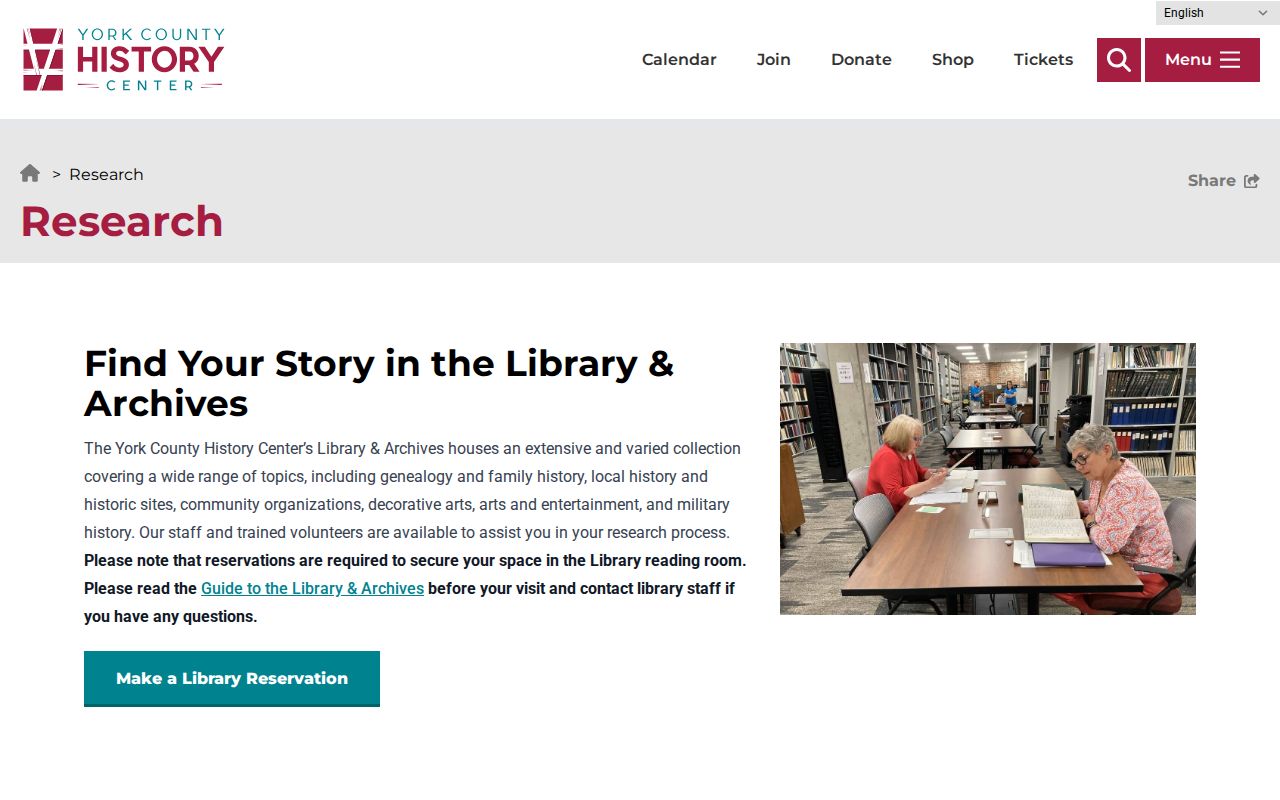
The Center also offers paid one-name, obituary, and business research requests. A one-name request checks 12 sources and is described as taking six to eight weeks, while obituary lookup timing varies with the death date supplied. Historic newspaper gaps remain possible.
Trace Dover Township Directory Households
A directory sequence is most useful when the research log keeps its dates visible. Pair one entry with the nearest public census snapshot, then test any address change with an old map, deed, tax record, or newspaper notice. Federal census records become public after 72 years, and the History Center holds Pennsylvania septennial-census microfilm for York County for 1786, 1793, 1800, and 1807. Those sources describe different moments, so they should be logged separately.
- Choose a verified York-area volume and search every likely surname spelling.
- Copy the printed entry and its page, then consult that volume's abbreviation key.
- Check a nearby year for a move, spelling change, or disappearance.
- Pair the dated entry with the nearest available census and identify conflicts instead of smoothing them away.
- Use maps, deeds, tax material, yearbooks, newspaper notices, or estate records to test the address and family connection.
A disappearance can reflect a move, death, a change in coverage, or simple omission. The York County Archives accepts detailed research requests by visit, email, or mail after index searching, but not by telephone. Its historical records and the History Center's newspaper and directory materials provide the practical fallback when an online name search stops.
Dover Township Directory Record Story
Dover's record trail is broader than its printed books. The Township says it formed in 1743, while a legacy PHMC source uses 1747 as an incorporation label. York County began in 1749, and its Archives routes old deeds, estates, court files, death records, and naturalizations by different date ranges. That layered history explains why a directory lead may need a county archive, not another book, to settle an earlier identity question.
In December 2025, the History Center announced a $5,000 PHMC HARC grant for expert assessment and preservation of digital archives. It is good news for preservation, but it does not mean every local directory has been digitized. Plan for repository research, use the published access rules, and preserve source citations for each finding.